Related Pages
Looking for technical details? See the Energy Renewal Plan (ERP)
Looking for an introductory overview? See the Energy topic page
Decarbonizing UW's Energy System
The University of Washington is transforming how energy is produced and delivered across the Seattle campus, replacing a century-old fossil fuel system with one powered by electricity and waste heat recovery. We call this effort the Pivot.
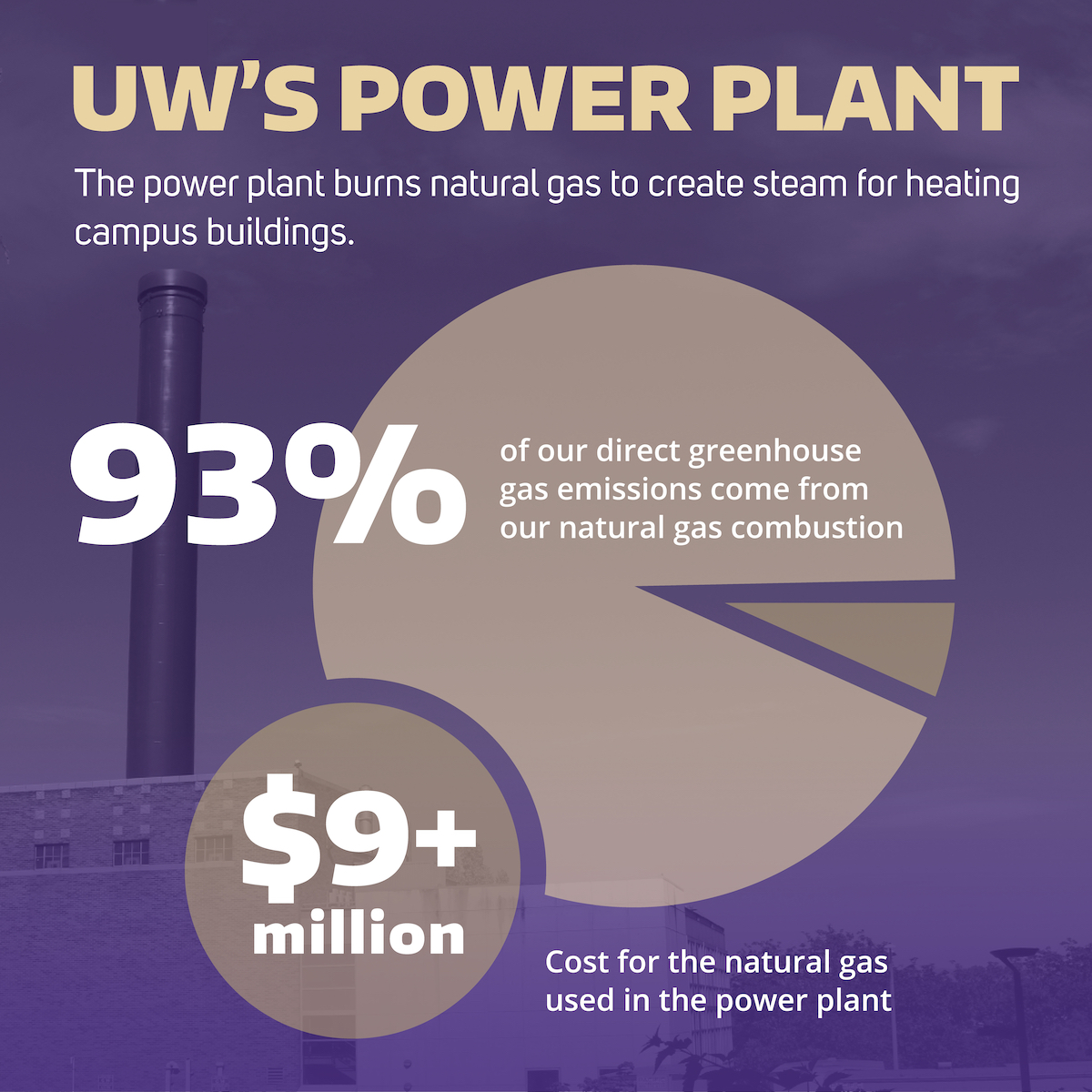
At the center of this effort is the UW Power Plant. Built in its current location in 1908, the plant burns natural gas to create steam that heats more than 130 buildings through miles of underground tunnels. This system has served the campus for over a century, but its infrastructure is aging and the emissions it generates are inconsistent with UW's goals and obligations. About 93% of UW's direct greenhouse gas emissions come from the natural gas used in the Power Plant, and that gas costs the UW about $9 million each year.
What we mean by "the Pivot"
The transformation ahead isn't incremental. It's a fundamental change in how UW produces, distributes, and thinks about energy. To get there we’ll need to make some big moves – pivots from what we’ve been doing to what the future requires.
- From natural gas to electricity. UW will stop combusting fossil fuels for heating and instead power its energy systems with electricity.
- From creating heat to moving heat. Rather than burning fuel to generate heat, UW will use heat pumps to capture thermal energy that already exists (in the campus cooling systems, in King County sewer lines, and potentially in Lake Washington) and move it to where it's needed.
- From independent systems to integrated ones. Today, heating and cooling operate separately. In the new system, heat pumps produce both simultaneously — the waste from one process becomes the input for the other.
- From steam to hot water. This is the foundational step which makes the other changes possible. By converting the campus heat distribution network to use hot water instead of steam meets heating needs more efficiently and makes electrification possible.
Why the Pivot is necessary
The case for change is driven by the combination of environmental goals, infrastructure risk, regulatory requirements, and growing campus needs.
- Aging infrastructure. Much of the Power Plant's equipment is well past its expected lifespan, with boilers ranging from 25 to more than 75 years old. Continued reliance on this equipment puts UW at increasing risk of service disruptions.
- Greenhouse gas mandates. Under Washington's Climate Commitment Act, the UW must purchase emission allowances with costs projected to reach $15 million annually by 2029 if emissions aren't reduced. The state's Clean Buildings Performance Standard also requires the UW to meet specific energy use targets.
- Electrical capacity. All electricity for the main Seattle campus enters through a single point, and the campus approaches its maximum load on hot summer days. Modernizing the energy system will expand capacity to meet growing cooling needs and new demand from the heat pumps.
- Institutional commitment. The UW's Faculty Senate passed a 2024 resolution calling for a 95% reduction in direct emissions by 2035. The ASUW student government has passed a resolution supporting decarbonization. And UW's Sustainability Action Plan makes the energy transformation a central priority.
The strategy
The UW has developed a comprehensive strategy to make the Pivot. The approach is designed to maintain reliable service throughout the transition while positioning us for a fully clean energy future.
The transformation involves coordinated work across several areas. Some of these efforts are already underway; others will come in future stages.
 Reduce energy demand. Moving away from fossil fuels will require more electricity use. To ensure we have the capacity to meet future demand, we also need to make our buildings more efficient. The UW is installing additional meters, upgrading building controls, and expanding data analytics to optimize energy use across campus. This work also helps comply with state and city building performance standards.
 Convert from steam to hot water. The current system distributes heat as high-temperature steam. Transitioning to a hot water distribution system is more efficient and is a necessary precondition for electrifying heating.
 Modernize and centralize cooling. Many campus buildings have their own aging, inefficient cooling systems. Centralizing cooling through the utility plants improves efficiency, frees up electrical capacity and provides a source of waste heat that can be captured to reduce the energy needed for heating.
 Electrify heating. This is the core of the transformation. Heat pumps powered by electricity will replace natural gas combustion. These heat pumps will capture waste heat from sources that are currently discarded, including campus cooling systems, King County sewer lines that run along the campus perimeter, and potentially from Lake Washington.
 Eliminate remaining fossil fuel use. Fully eliminating fossil fuels will require finding alternatives for the steam still needed to sterilize research and medical equipment. The UW is monitoring developing technologies to address this remaining challenge.
What's happening now
The Pivot is already underway. In 2024 the Power Plant Reliability Project was completed, standardizing campus boilers and achieving a reduction of more than 10,000 metric tons of CO₂e per year and paving the way for removing boilers. In 2024, UW also completed the Energy Renewal Plan, a comprehensive implementation plan outlining the projects, phasing, and funding needed to execute the transformation. In June 2025, UW submitted a Seattle Campus Decarbonization Plan to the Washington Department of Commerce.
The 2024 state budget included $38.9 million for initial energy renewal and decarbonization projects, including centralized chilled water improvements, UW Tacoma gas boiler replacements, and medical center HVAC system renewal. See all current and proposed decarbonization projects.
Go Deeper: Understanding the Pivot
The strategy and its outcomes
- Decarbonization overview poster (PDF) — 2024. The most current summary of the Pivot: the five-part strategy, the challenges driving change, and the anticipated outcomes.
- 2025 Energy presentation (PDF 3.5MB). Anticipated outcomes of the Pivot: efficiency gains (shown as a Sankey diagram), impact on electrical capacity, projected costs and NPV, and a timeline of construction across campus.
- 2022 Energy presentation (PDF 8.3MB). An earlier 21-slide presentation illustrating the five-part strategy with 3D-schematic diagrams. Predates the "Pivot" name but covers the same strategy.
- Five-part strategy poster (PDF) — 2022. An earlier version of the decarbonization overview poster above.
Key technologies
- Electrifying heating poster (PDF) — 2022. Diagram explaining how heating and cooling systems, currently independent, will be integrated through heat pumps to produce both simultaneously.
- Recycling sewer energy poster (PDF) — 2024. How heat can be extracted from sewage, with a map showing major sewer lines passing close to the Seattle campus.
- Chilled water storage poster (PDF 2.7MB) — 2022. How a large tank can smooth electrical demand across a day by storing chilled water when it isn't needed and dispatching it when demand is high.
Resilience and co-benefits
- Resilience poster (PDF 405KB) — 2022. How centralizing cooling and deploying thermal energy storage gives UW resilience in meeting the electrical needs of research, patient care, and archival storage.
- Salmon assistance poster (PDF 2MB) — 2023. How pulling heat and cooling from Lake Washington may benefit salmon migrating through the Ship Canal.
Video presentations
There have been several presentations around the UW's decarbonization work. Watch here or click below to see the full playlist.