The existing campus heating system, currently powered by fossil fuel combustion boilers and steam distribution, will be replaced with an electrified system. This new system will utilize heat pump technology to capture energy from on-campus and nearby sources, delivering it to campus buildings through a medium-temperature hot water system.
What are heat pumps?
Heat pumps transfer energy from one place to another, rather than producing it themselves. They can extract heat from the air, ground, or water, and are thus able to provide year-round heating and cooling. They use a relatively small amount of electricity to move heat from one place (the heat source) to another (the destination).
How do they work?
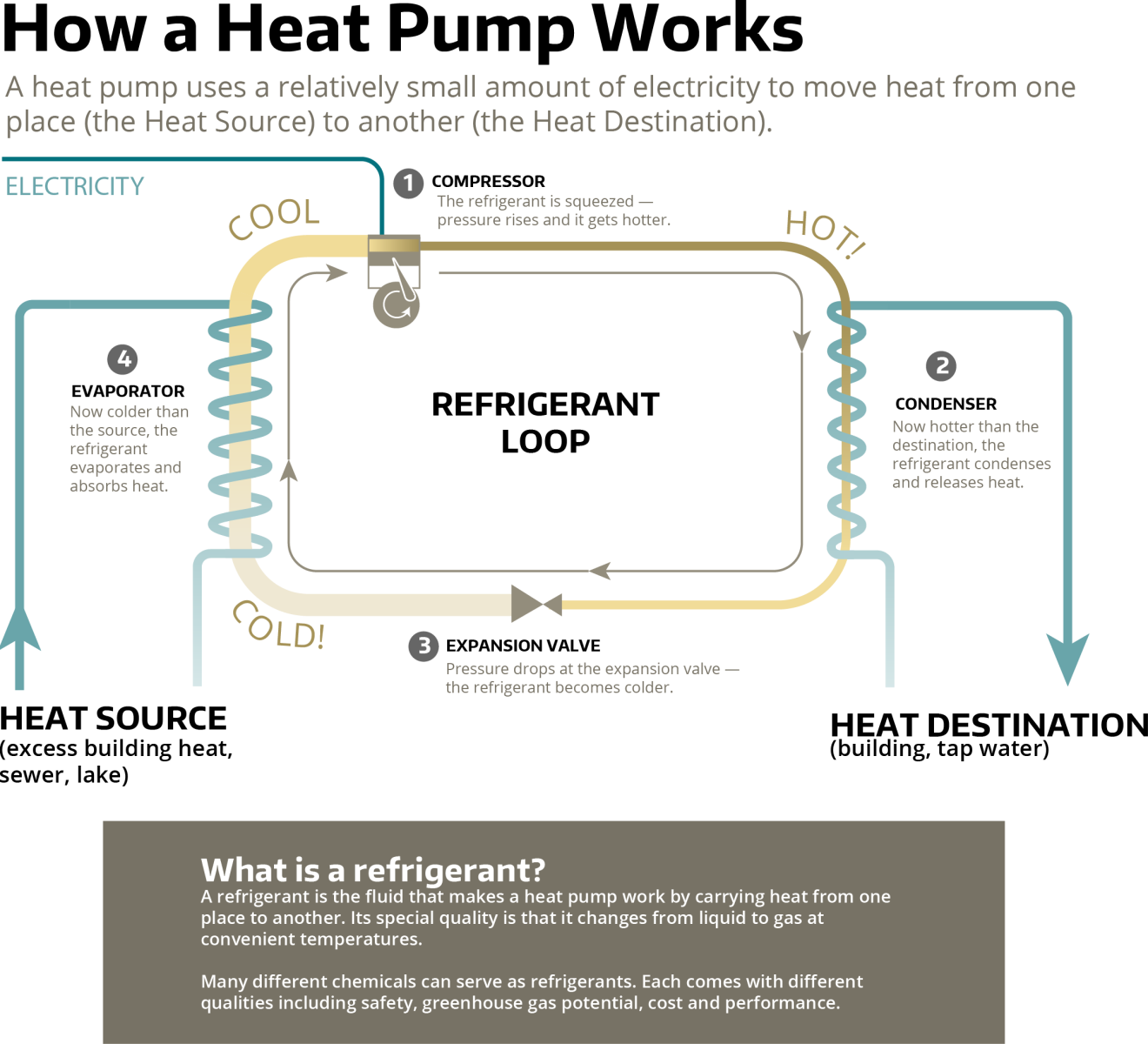
The diagram above shows how a heat pump uses a refrigerant loop to transfer heat. Electricity powers a compressor, which squeezes cool refrigerant to increase pressure which raises temperature. The hot refrigerant then moves through a condenser coil - as the refrigerant is now hotter than the destination, it condenses and releases heat which goes to the destination.
The loop then meets an expansion valve, which allows the pressure to drop and cools the refrigerant. This cool refrigerant then passes through an evaporator with heat coming from the heat source. As the refrigerant is cooler than the source, it evaporates and absorbs heat. It then goes to the compressor, restarting the cycle.
Heating cycle:
- Evaporation: A refrigerant flows through the evaporator, turning into gas after absorbing heat from the ground, air, or water.
- Compression: The pressure and temperature of the gas increases as it flows through the compressor.
- Condensation: Hot gas flows into the condenser; the refrigerant then releases heat as it cools down and turns into a liquid. This heat warms the inside of the building.
- Expansion: The refrigerant passes through the expansion valve, which further reduces its temperature and pressure. The cooled refrigerant then returns to the evaporator and the cycle continues.
What is a refrigerant?
A refrigerant is a fluid that makes a heat pump work by carrying heat from one place to another. Its special quality is that it changes from liquid to gas at convenient temperatures. Many different chemicals can serve as a refrigerant. They each have different qualities affecting safety, greenhouse gas potential, cost and performance.
Why heat pumps?
Heat pumps are extremely efficient. Because they transfer heat rather than produce it, they are able to move 3-4 times more thermal energy than the electrical energy they consume. They do not burn fossil fuels directly, resulting in fewer greenhouse gas emissions.