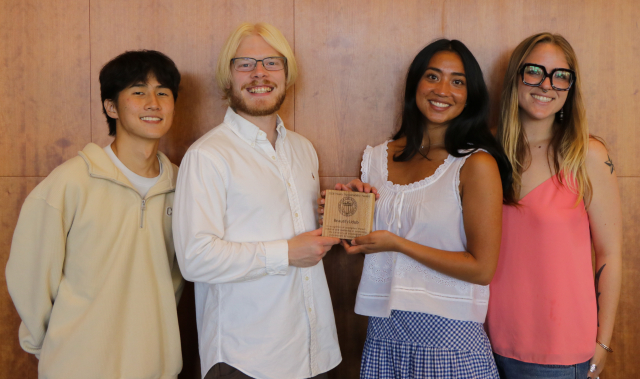
BeautifyUdub started four years ago as a small litter cleanup effort among first-year students. Since that initial effort, the group has evolved into one of the UW’s most active and community-driven organizations. BeautifyUdub has hosted nearly 135 events and engaged more than 400 students in cleanup efforts across campus as well as local neighborhoods, parks and beaches throughout Seattle. Beyond just litter pickup, BeautifyUdub has helped organize clothing swaps focused on reducing textile waste, and has held events at UW Farm to educate students on food systems. They’ve also advocated for broader environmental policy efforts including Extended Producer Responsibility legislation in Washington State. A core commitment of the organization is to provide students with opportunities to lead from the moment they join. Through hands-on stewardship, BeautifyUdub has built a lasting culture of environmental action on campus, and their work has inspired numerous young leaders to advocate for the environmental policies they believe in.
Husky Sustainability Awards 2026
The Husky Sustainability Awards recognize individuals and groups across all UW campuses who lead the way for sustainability at the University of Washington. This is the 17th year awards have been given by the UW Environmental Stewardship Committee.
photos from the award ceremony
The Husky Sustainability Awards are given to students, faculty and staff from the Seattle, Bothell and Tacoma campuses who show impact, initiative and leadership around sustainability. The 2026 recipients are:
BeautifyUdub
Eric Camp & Larry Goldman
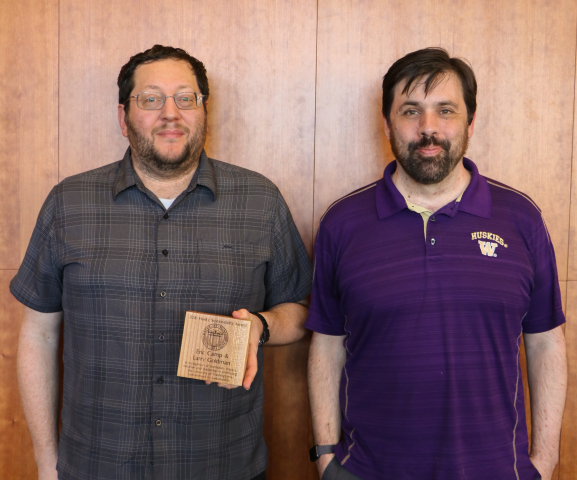
Eric Camp and Larry Goldman have worked to ensure sustainability is built into the lab operations of UW’s Department of Chemistry. Eric is the department’s Director of Undergraduate Services, responsible for the labs where thousands of undergraduates learn each year. As part of the UW’s Green Labs Working Group, Eric designed and piloted a low-cost recirculating water system which reduces the need to run tap water continuously during experiments. This is projected to save about 40,000 gallons of water each year. As an Associate Teaching Professor, Larry has integrated Green Chemistry concepts directly into his organic chemistry coursework, helping students familiarize themselves with sustainable chemistry in more technical settings. They are further collaborating by co-supervising a student intern who will research additional opportunities to make lab experiments more sustainable. Their work connects operational improvements in chemistry labs with curriculum, positively impacting the ways students think about their own environmental responsibility and serving as a model the Green Labs program can share with other groups to amplify the impact.
School of Nursing Simulation Center
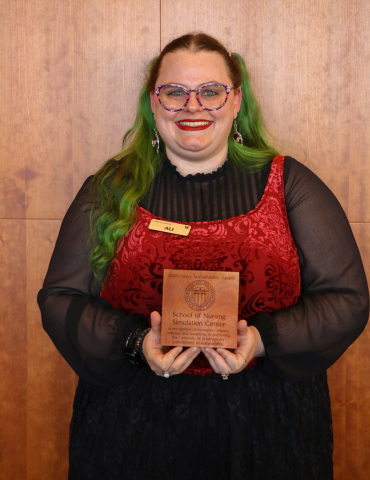
The UW School of Nursing Sim Center (UW SoN Sim) had been a major consumer of single-use health care materials for training undergraduate and graduate students. There has traditionally been a reluctance by students to practice with previously-used kits or supplies. This led to generation of large amounts of waste in order to practice skills such as central line insertion or urinary catheterization. In recent years, the team systematically evaluated actual needs and began using non-usable materials from UW Medicine facilities, such as expired equipment or items which were opened but not used. In addition, at the end of each quarter, the team has a "repackage" session where student-used kits and supplies are repackaged to be used in training. Along with evaluating purchasing and inventory to ensure they are only buying what is needed, these efforts have reduced the amount of waste produced by the Simulation Center by 90% while keeping a high level of student satisfaction and becoming a national model for sustainability in nursing simulation centers.
Casey Cockerham
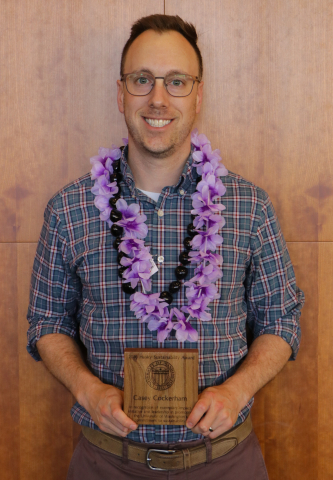
Casey Cockerham is a mechanical engineer with UW Facilities. He led a comprehensive water audit across the Seattle campus that uncovered major leaks and monitoring issues, leading to substantial cost savings and reduced water waste. His work identified and corrected equipment issues in some meters, and prioritized high-consumption buildings for the greatest impact. Through his initiative, the audit led to an expanded ongoing program to continue monitoring and optimizing the UW’s water use. Driven by his own initiative and commitment to the core principles of sustainability, much of this work has extended beyond his formal responsibilities. Through collaboration with different facilities teams, university leadership and resource conservation staff, Casey’s work has made a lasting impact on infrastructure planning at UW.
Gabriel Kennedy-Gibbens
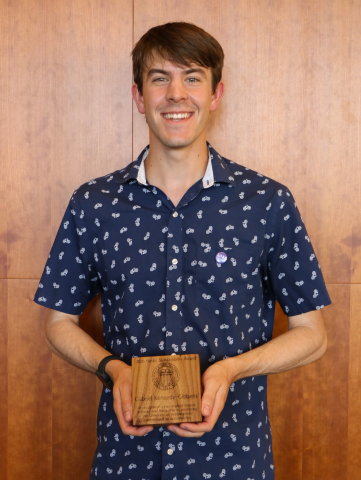
In his four years as a UW student, Gabriel Kennedy-Gibbens has been deeply involved in many different avenues for sustainability. He has led many climate advocacy efforts, organizing projects that helped push larger conversations around decarbonization further into public view at UW. He has held leadership roles in the student groups Institutional Climate Action, UW Solar and the Society for Ecological Restoration. His impact can already be felt on campus, where he’s been the co-manager of the ongoing restoration work at Yesler Swamp and helped UW Solar advance the E18 solar canopy project. He’s also worked to create longer-term impact, advocating for urgent action on climate change at UW and beyond while encouraging others and empowering the next generation of student sustainability leaders as a warm, welcoming, enthusiastic and powerful presence in the UW sustainability and activism communities.
Stefan Wheat
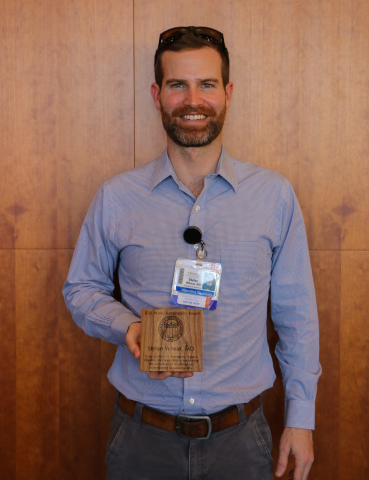
Dr. Stefan Wheat is an emergency physician and faculty member in the UW School of Medicine. He has worked to embed climate responsibility, environmental stewardship and equity directly into UW Medicine’s education and clinical culture. He serves as the School of Medicine’s Planetary Health Theme Director, implementing a curriculum that motivates future healthcare professionals to think critically about the ways climate conditions shape public health outcomes. Students have been encouraged to recognize how healthcare systems contribute to things like resource use and waste, an approach that is grounded in clinical reality. Dr. Wheat also leads the UW Medicine Climate Change and Clinical Practice Symposium, an event that has brought together professionals from across the Pacific Northwest to discuss sustainable approaches to healthcare delivery. His work received national recognition in 2025 as he was named an Association of American Medical Colleges Climate Champion.
Legacy winner: Marilyn Ostergren
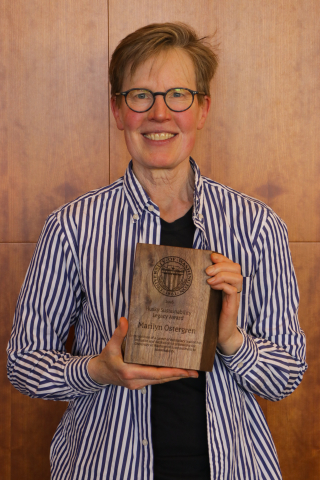
Marilyn has been part of UW Sustainability since the office was created, and has been passionately working and advocating for sustainability for much longer.
Now the Energy & Sustainability Specialist at UW Sustainability, Marilyn’s first role with would become UW Sustainability came even before the office was officially formed as she created graphics for the UW's original Climate Action Plan, published in 2009. She then created a sustainability data dashboard while a doctoral student in the iSchool. That project transitioned into a staff position where Marilyn has taken on several roles, largely around the UW’s energy systems and greenhouse gas emissions. Although her background is primarily in visual design (she taught courses on infographics through the iSchool for several years), Marilyn’s desire to be a driving force around sustainability has led her to gain a deep understanding on a broad array of topics so that she could meaningfully advise and contribute to the UW’s efforts. Marilyn combines a strong curiosity and optimism with an understanding of the urgency and importance of sustainability climate change in all her work at the UW.
She lives the values of sustainability every day, as well. Marilyn built her own straw-bale home on Bainbridge Island, learning how to do as much of the work as she could, and leaning on local experts when needed. She continues to update the house and garden, which she is looking forward to spending even more time in after her retirement this summer.
Legacy winner: Robert B. Peña
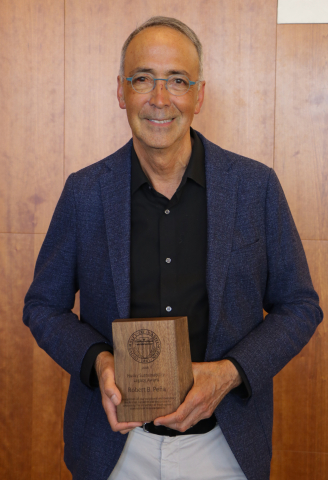
Over the course of almost two decades, Robert Peña has made significant contributions to sustainability through both hands-on project work and broader student engagement. As an Associate Professor and Graduate Program Coordinator in the Department of Architecture, Rob has led seminars, lectures, and studio courses focused on climate-responsive design, high-performance buildings and net-zero energy strategies. He has consistently supported student sustainability efforts, advising the UW Solar Decathlon team and UW Sun Dawg which aims to create solar-powered installations around campus. He has long been active in the UW’s sustainability work, serving on the Environmental Stewardship Committee since 2008 and as a member of the sustainability awards selection committee since the awards program was instituted in 2010.
Rob was a key contributor in the research, design and interpretation of the Bullitt Center, regarded as one of the greenest commercial buildings in the world and one of the region's most influential sustainability projects. He has presented internationally and was inducted as a Fellow of the American Solar Energy Society in 2024. His enthusiasm for sustainable design has shaped classrooms and conversations at the UW and far beyond.
Legacy winner: UW Food Pantry
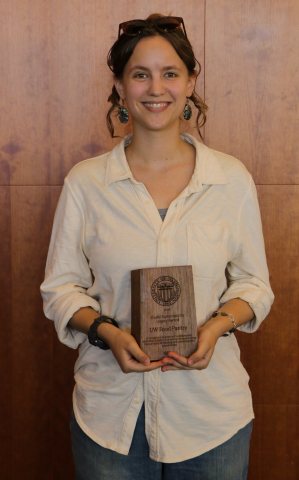
The UW Food Pantry provides an essential resource for the University community while working to ensure it does so in a welcoming and inclusive manner. Since first launched as a permanent program in 2018, demand has only risen - and the Pantry team, largely comprised of students, has worked to find ways to expand their offerings and become an integral part of the UW’s food system.
In a 2019 study of UW students, 20% indicated they “sometimes” or “often” ran out of food and did not have enough money to buy more. Thousands of students and staff rely on the Pantry, which focuses on sourcing and distributing food sustainably while creating a space where food access and community care are closely connected.
The Pantry focuses a lot of their work on recovering and then redistributing food that would otherwise go to waste through donations and partnerships across campus. They have strong partnerships with Housing & Food Services and the UW Farm to offer students a wide range of food including fresh produce. Their team also pays close attention to the types of food that is being offered, keeping accessibility, nutrition, culture and the campus population in mind. Their volunteers and staff consistently work with limited resources to intentionally improve their operations and also support and collaborate with other efforts on campus.