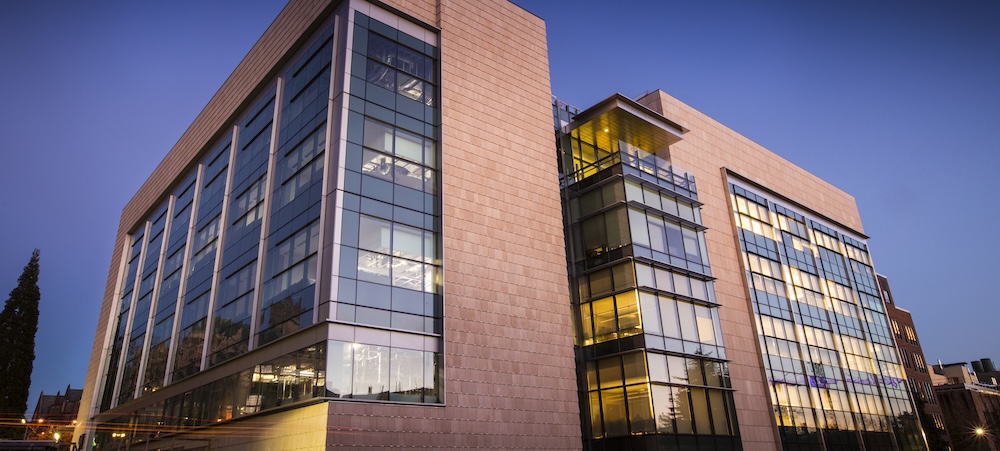
The UW's Molecular Engineering and Sciences Building (MolES) incorporates innovative strategies for energy savings and sustainability. Reducing the number of air changes by 40% lightens the load on the mechanical systems that serve technically challenging laboratories, while operable office windows and solar chimneys are part of a more "organic" approach to heating and cooling. Phase change material fills the gap in walls and ceilings, and works by solidifying at cooler temperatures to retain heat while liquefying at warmer temperatures to facilitate heat exchange between the building and the outside. Concrete frame construction and partially exposed concrete floors do dual duty absorbing excess heat in summer and providing warmth in winter.
Innovative strategies reduced the heating load caused by the sun by 80%. This allowed natural ventilation to replace AC systems in the office spaces. In the labs where automated ventilation is required, the architects decreased the amount of air exchanged by these systems by 40%.
In the walls, small, plastic squares of non-toxic vegetable-based gel absorbs unneeded heat before it enters the room and freezes at 74°F to retain heat inside.